Gambler’s Fallacy is one of the most common cognitive biases that affects how sports results are interpreted, because it makes the Kuwaiti player believe that when a certain result repeats, the opposite result has become close or necessary. In sports, this way of thinking can lead to sports analysis mistakes when a team or player is judged only through a short streak of results, without looking at performance quality, opponent level, absences, fixture congestion, or the technical indicators that explain what actually happened on the field.
In this article, we will explain the meaning of Gambler’s Fallacy in sports, why it appears when the Kuwaiti player analyzes winning and losing streaks, and how it turns into one of the common sports analysis mistakes. We will also explain the difference between result and performance, the importance of sample size, the indicators that should be checked before building any prediction, and the difference between Gambler’s Fallacy and regression to the mean, with a checklist that helps read matches in a more accurate and balanced way.
Our Recommended Casinos That Offer Non-Free Slots Games

Bonus up to
$3,500 + 200 FS

Bonus up to
$5,000

Bonus up to
$1,000 + 500 FS
What Is Gambler’s Fallacy?
Gambler’s Fallacy is defined as a false belief held by the Kuwaiti player that previous results automatically correct themselves in upcoming outcomes. In other words, the Kuwaiti player assumes that when a certain result repeats, the opposite result becomes more likely, even when there is no real reason to support that belief.
In sports, Gambler’s Fallacy appears when a winning or losing streak is treated as if it were a fixed rule. The Kuwaiti player may see a repeated sequence of results and then assume that a change has become necessary. The problem is that this assumption is not based on performance analysis, but on a psychological feeling that balance must return.
This type of thinking is one of the most common sports analysis mistakes, because it turns a numerical streak into a final conclusion. A streak may be important, but it is not enough on its own. You should always ask: What caused this streak? Did it happen because of strong performance? Did it happen because of continued weakness? Was it affected by injuries? Were the opponents stronger or weaker than average?
| Element | Wrong Reading | Better Reading |
| Repeated result streak | The next result must be the opposite | The streak needs performance-based explanation |
| No goals scored | Scoring has automatically become close | Chance quality must be checked |
| Repeated wins | A loss has become inevitable | Performance strength must be checked |
| Repeated losses | A win has become close | The reasons behind the losses must be checked |
| Results of the last 3 matches | A clear trend | A small sample that requires caution |
Understanding Gambler’s Fallacy helps build calmer analysis. Instead of following quick statements, the focus shifts to data and context. This is very important because sports analysis mistakes do not always come from a lack of information; sometimes they come from reading information inaccurately.
Why Does Gambler’s Fallacy Appear in Sports?

Gambler’s Fallacy appears in sports because the Kuwaiti player always tries to find a pattern inside results. The mind tends to organize events and connect them to each other, even when the link is weak. When a certain result repeats, the feeling begins that change is now close, and this is exactly what creates the error in sports analysis.
Sports increase this effect because they combine numbers and emotion. There are favorite teams, famous players, surprising results, and media pressure around streaks. All of these factors make judgment about the next match more influenced by impression than analysis.
On the other hand, many sports analysis mistakes appear because of relying on small samples. The last two or three matches are not enough to judge the level of an entire team. Even 5 matches can be misleading if the type of opponents, fixture schedule, and influential injuries are not examined.
| Cause of Gambler’s Fallacy | How It Affects Analysis |
| Searching for a quick pattern | Makes the streak look stronger than its real value |
| Focusing on the final result | Hides performance details |
| Emotion toward a team or player | Weakens neutrality |
| Ignoring sample size | Exaggerates short-term results |
| Relying on impression | Increases sports analysis mistakes |
That is why this should be treated as an error in the way of thinking, not only as an error in numbers. The problem is not knowing whether the team won or lost, but turning this information into a definite prediction without enough foundation.
The Difference Between Result and Performance
One of the biggest causes of Gambler’s Fallacy is confusing result with performance. The result is what appears at the end of the match, while performance is what happened inside the match: chances, shots, positioning, pressure, defensive mistakes, build-up quality, and the team’s ability to control play or create danger.
Sports analysis mistakes appear when a team is judged only by the result. Winning does not always mean strong performance, and losing does not always mean weak performance. Therefore, the previous streak alone cannot be used to build an accurate prediction.
| Indicator | Meaning | Importance |
| Number of shots | Volume of attacking attempts | Shows team activity |
| Shots on target | Quality of reaching the goal | Better than general shots |
| Big chances | Danger level of attacks | Reveals chance creation quality |
| Expected goals | Numerical quality of chances | Reduces reliance on result only |
| Defensive mistakes | Source of conceded goals | Explains repeated losses |
| Absences | Effect on the lineup | Changes the reading of performance |
| Fixture congestion | Physical fatigue | Affects consistency |
When these indicators are ignored, the error becomes more present. The Kuwaiti player sees a streak of results, but does not see the details that produced it. Better analysis separates what happened in the result from what happened in the performance.
This separation is necessary to reduce sports analysis mistakes. When performance is analyzed independently, it becomes possible to know whether the streak is the result of a real problem or just a short period that is not enough for judgment.
How Do Short Streaks Turn Into Sports Analysis Mistakes?

Short streaks are among the most dangerous areas in sports analysis. The last 3 or 4 matches may create a strong impression, but they do not always provide enough evidence. Gambler’s Fallacy feeds on these streaks because it makes the Kuwaiti player feel that change has become close or that continuation has become impossible.
The problem is that a short streak may be affected by many factors that do not appear in the final result. Therefore, it should not be treated as a complete fact. A winning streak may hide weak defensive performance, and a losing streak may hide improvement in chance creation. Without analyzing the details, the streak becomes a direct source of sports analysis mistakes.
| Streak Size | Reliability Level | How to Treat It |
| One match | Very weak | Not suitable for general judgment |
| 3 matches | Weak | Only an initial indicator |
| 5 matches | Medium | Needs comparison with performance |
| 10 matches | Better | Helps identify a trend |
| 20 matches | Stronger | Suitable for relatively long-term comparison |
This does not mean that short streaks have no value, but they are not enough on their own. They should be used as the beginning of the question, not the end of the analysis. When a streak turns into a final judgment, Gambler’s Fallacy has entered the way of thinking.
The Right Sample Size Before Making a Judgment
Sample size is one of the most important elements in avoiding Gambler’s Fallacy. The smaller the sample, the higher the risk of rushing to judgment. The larger the sample, the more capable the analysis becomes of distinguishing between real performance and temporary fluctuation.
In sports analysis, relying on only 3 matches may lead to sports analysis mistakes, because this period is very short and may be connected to special circumstances. A sample of 10 matches gives a better reading, but it also needs context. A larger sample, such as 20 matches, helps show the general direction more clearly.
| Sample Size | Benefit | Risk |
| 1 to 3 matches | Capturing a quick change | Exaggerating a temporary result |
| 4 to 5 matches | Noticing the beginning of a pattern | Can be affected by opponents |
| 6 to 10 matches | A better reading of performance | Needs breakdown by opponents |
| 11 to 20 matches | A clearer direction | May hide recent changes |
| Full season | Comprehensive evaluation | May not reflect the current condition |
Good analysis does not always choose one fixed sample size. Instead, it balances the recent and the long-term view. Recent performance is important, but long-term performance prevents rushed judgment. This balance reduces the effect of Gambler’s Fallacy, because it prevents a short streak from being turned into a fixed rule.
Indicators That Should Be Checked Before Building a Prediction
To avoid major mistakes, a group of indicators should be checked before building any sports reading. Relying only on wins and losses makes the analysis superficial. Using multiple indicators reduces sports analysis mistakes and brings the judgment closer to reality.
Attacking Indicators
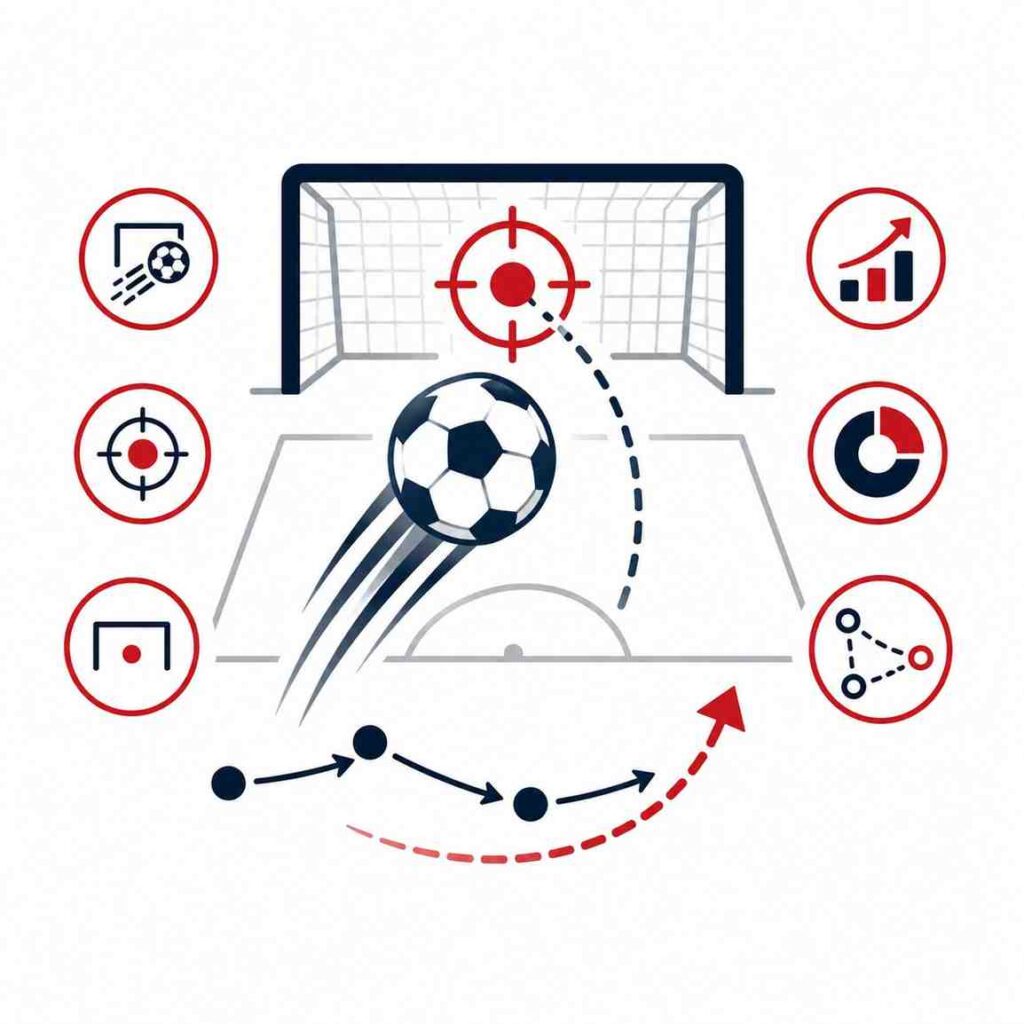
- Number of shots in the match.
- Number of shots on target.
- Number of big chances.
- Touches inside the penalty area.
- Chance conversion rate into goals.
- Quality of passes in the final third.
- Number of organized attacks compared with random attacks.
Defensive Indicators
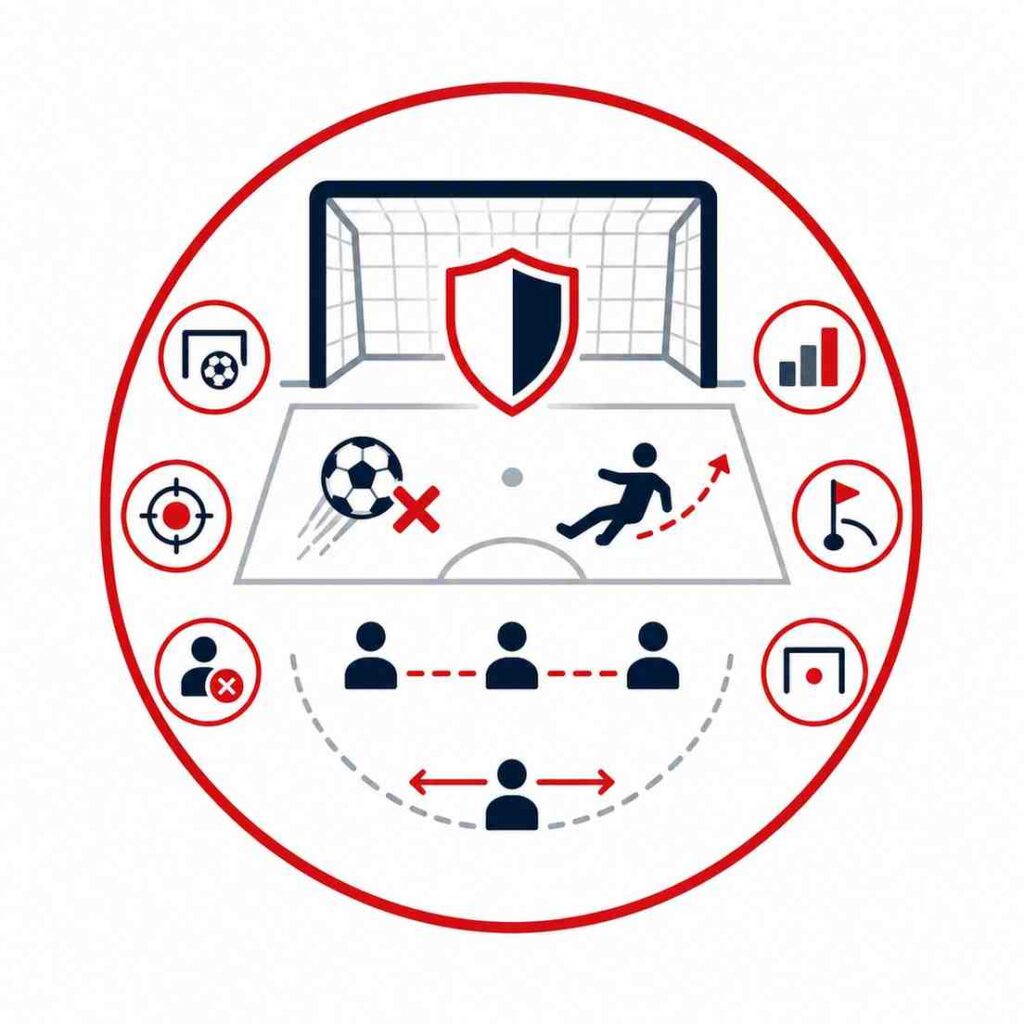
- Number of shots conceded.
- Quality of chances the team gives to opponents.
- Number of influential individual mistakes.
- Strength of defensive positioning.
- Handling set pieces.
- Number of times the opponent reaches the penalty area.
- The team’s ability to close spaces.
Contextual Indicators
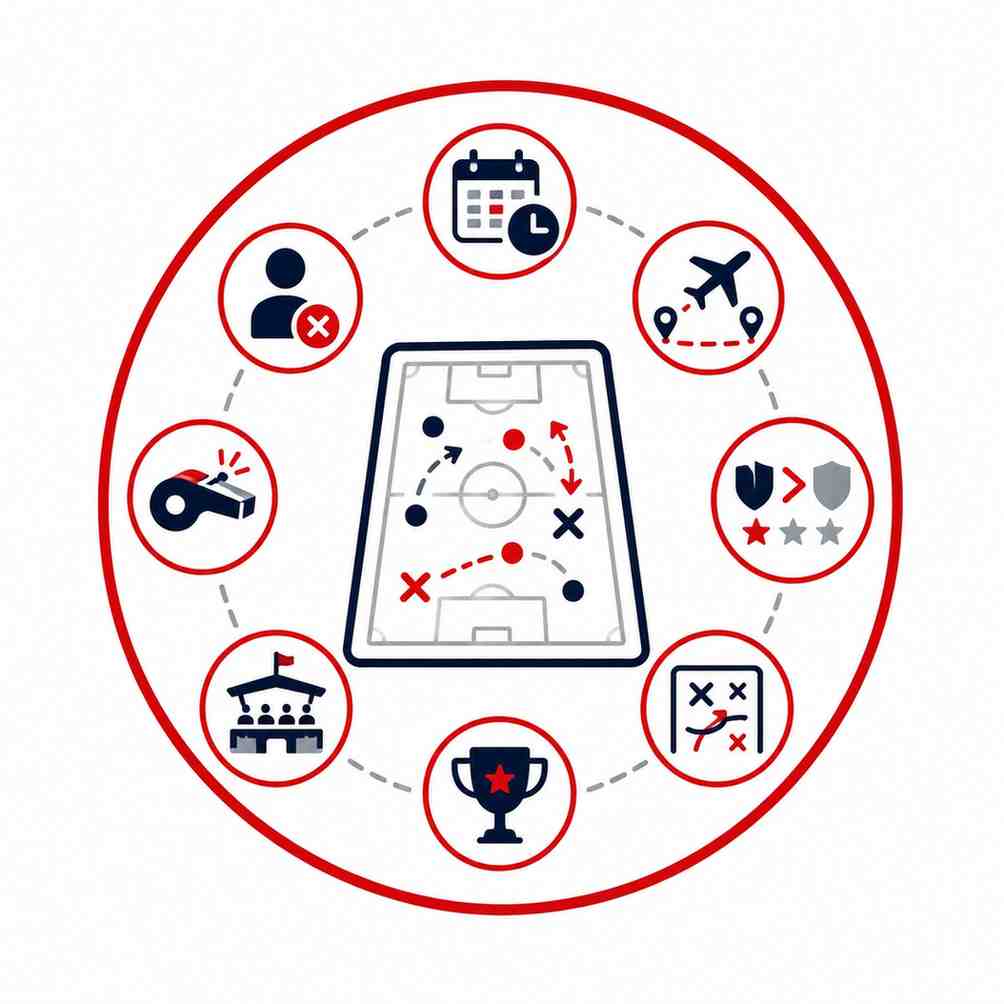
- Key absences.
- Fatigue caused by fixture congestion.
- Travel and distance between matches.
- Level of previous opponents.
- Importance of the match.
- Change in coach or tactical plan.
- Home advantage and crowd effect.
These indicators make the analysis based on reasons, not on a feeling that the streak will end or continue. That is why they are practical tools for reducing sports analysis mistakes.
Gambler’s Fallacy and Regression to the Mean
It is important to distinguish between Gambler’s Fallacy and regression to the mean. Regression to the mean is an analytical concept that means extreme performance may gradually return to a level closer to the normal average. However, this does not mean that the next result is guaranteed.
The mistake, or the gambler’s illusion, says that the opposite will happen because a certain result has repeated many times. Regression to the mean, on the other hand, requires a numerical comparison between current performance and the usual level. This difference is very important, because confusing the two concepts causes sports analysis mistakes.
| Element | Gambler’s Fallacy | Regression to the Mean |
| Basis | A feeling of upcoming balance | Numerical comparison |
| Judgment method | The streak has lasted long, so it will end | Current performance is far from the average |
| Accuracy level | Weak | Better if based on enough data |
| Risk | A definite prediction without evidence | Misusing the sample |
| Relationship to analysis | Cognitive bias | A tool that requires caution |
Using regression to the mean correctly can help in analysis. But it becomes a form of Gambler’s Fallacy when it is used without enough data. Therefore, averages, sample size, and the stability of indicators should always be checked before building any conclusion.
How Does Gambler’s Fallacy Affect Team Reading?
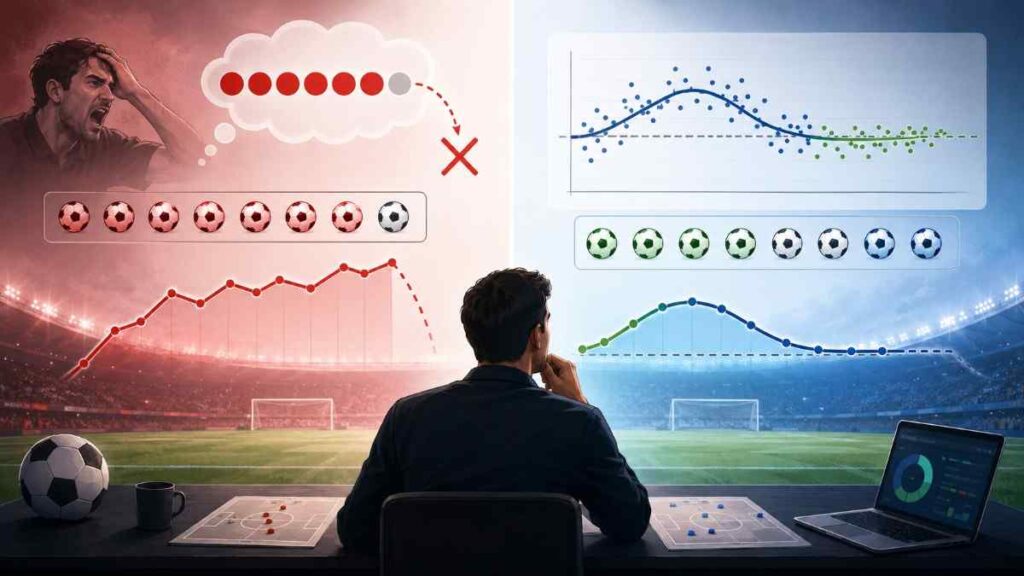
Gambler’s Fallacy affects team reading because it makes the Kuwaiti player reduce everything to the streak. A team going through a period of negative results may be in real decline, or its performance may be better than its results. A team achieving positive results may genuinely be strong, or it may be benefiting from temporary details.
Sports analysis mistakes appear when these cases are not distinguished from each other. Reading a team requires more than knowing its latest results. The playing style, opponent level, chance quality, and defensive stability must be understood. When these elements are ignored, Gambler’s Fallacy becomes an inaccurate guide for analysis.
| Reading Area | What Should Be Analyzed? |
| Results | Comparing actual results with the level of performance on the field |
| Attack | Volume of created chances, shot quality, and number of dangerous attacks |
| Defense | Number of dangerous chances given to opponents and how the team handles pressure |
| Midfield | The team’s ability to control the rhythm of the match and build play |
| Absences | The effect of missing key players or players with important roles |
| Schedule | Fixture congestion, travel, lack of rest, and physical fatigue |
| Opponents | The strength of the teams faced and whether the results came against difficult or easy opponents |
These factors prevent reducing a team to a winning or losing streak. That is why they are necessary for avoiding mistakes and reducing sports analysis mistakes.
How Does Gambler’s Fallacy Affect Player Reading?
Gambler’s Fallacy is not limited to teams; it also appears when evaluating players. A player may go through a period without scoring or assisting, so he is judged too quickly. He may also go through a highly productive period, so a decline is assumed to be inevitable. In both cases, the reading may be inaccurate if it is not connected to performance.
Player evaluation needs detailed indicators, because an individual result may be affected by his position, team role, quality of teammates, opponent strength, and number of minutes played. That is why judging a player from one number only is one of the sports analysis mistakes.
| Player Indicator | Importance |
| Minutes played | Determines the level of involvement |
| Shots | Shows attacking activity |
| Shots on target | Shows the quality of attempts |
| Touches inside the box | Reveals closeness to scoring |
| Key passes | Measures chance creation |
| Defensive roles | Important for non-attacking players |
| Position within the tactical plan | Changes how the numbers should be interpreted |
When a player is viewed this way, the margin of error becomes smaller. The question is no longer: when will this sequence end? Instead, it becomes: is there performance that supports a change in results?
Checklist for Avoiding Sports Analysis Mistakes

Before building any sports reading, a simple checklist can be used. Its goal is not to reach complete certainty, but to reduce the effect of Gambler’s Fallacy and force the analysis to pass through clear questions.
- The sample size should be enough before judging the streak.
- Actual performance should be checked, not only the result.
- The streak should be read with the level of opponents the team faced.
- Influential injuries and absences may change how results are read.
- Attacking numbers should support any prediction related to the team’s ability to score.
- Defensive numbers help explain results, whether positive or negative.
- Any recent tactical change should be considered before building the prediction.
- Fixture congestion may affect physical performance and focus inside the match.
- Current performance should be compared with the team’s previous average.
- Definitive phrases such as “must” or “certainly” may indicate undisciplined analysis.
- The prediction should be based on a clear reason, not only on a feeling or impression.
- The Kuwaiti player’s personal impression should be separated from measurable data.
This checklist helps detect the mistake before it turns into a final judgment. It also helps reduce sports analysis mistakes because it makes the decision based on a group of factors, not only on a short streak.
Practical Rules for Avoiding Gambler’s Fallacy
Avoiding Gambler’s Fallacy requires an organized way of thinking and following betting tips and strategies. It is not enough to know the meaning of the term; it must be applied when reading results. That is why a set of simple rules can be used:
- Do not judge based on the last result only.
- Do not treat the streak as enough evidence.
- Do not use the word “certainly” without indicators.
- Separate performance from result.
- Read the absences before reading the streak.
- Compare previous opponents with the level of the upcoming opponent.
- Use more than one attacking and defensive indicator.
- Check the sample size before building judgment.
- Accept that sports include natural fluctuation.
These rules do not always guarantee a correct prediction, but they prevent the clearest sports analysis mistakes. The goal is not to reach complete certainty, but to build a more rational reading.
Conclusion About Gambler’s Fallacy
Gambler’s Fallacy in sports appears when it is believed that the next result must compensate for previous results. This belief may seem convincing, but it leads to sports analysis mistakes when it depends on the streak alone without checking performance and context.
Short streaks are not enough for judgment, and the final result does not explain everything. Better analysis needs a wider reading that includes chance quality, number of shots, absences, fixture congestion, opponent level, and tactical changes. In this way, it becomes possible to understand whether the results reflect real performance or just a short period that should not be exaggerated.
Avoiding the illusion does not mean ignoring numbers; it means using them correctly. The streak may be a good starting point for analysis, but it should not be the end of it. The more the analysis is based on clear indicators, the fewer sports analysis mistakes there will be, and the more accurate and balanced the judgment becomes.
What does Gambler’s Fallacy mean in sports analysis?
The term refers to the belief that a certain result has become “necessary” only because it has not happened for a while, such as expecting a team to win because it lost several matches in a row without any technical evidence supporting that.
Do consecutive losses mean that a win is close?
No. Consecutive losses do not automatically mean that a win is coming. Performance, opponent quality, injuries, attacking numbers, and defensive numbers must be analyzed, instead of relying on the idea that the streak “must end”.
How does the fallacy affect match predictions?
It makes the Kuwaiti player exaggerate the importance of previous results and ignore actual data. For example, he may expect a team to draw because it has won many times recently, even though its level is still strong and its attacking chances are high.
What is the difference between reading a streak and applying Gambler’s Fallacy?
Reading a streak means studying why the results repeated: was it because of good performance, weak opponents, absences, or fixture congestion? Gambler’s Fallacy means expecting the result to change only because the pattern has repeated many times.
How can I avoid Gambler’s Fallacy when analyzing sports?
Avoid definitive phrases such as “he will certainly lose” or “he must win”, and review basic data such as chance quality, opponent level, absences, defensive and attacking performance, and sample size before building any prediction.