Sports Betting Regulation in the Middle East has become an important topic for Kuwaiti players, especially with the spread of global betting sites, live streaming, football markets, and bonuses targeting players from the region. However, the presence of these sites does not mean that laws are the same in every country, and it does not mean that Kuwaiti players receive local protection when using an offshore platform.
The situation in the region differs from one market to another. Some countries still clearly ban betting, while others have started discussing or applying regulatory models linked to commercial gaming. Kuwait, meanwhile, remains more conservative when it comes to local licensing. Therefore, players need to understand the difference between prohibition, regulation, and offshore licensing before dealing with any betting site.
In this article, we will explain the meaning of Sports Betting Regulation in the Middle East, Kuwait’s position compared to some regional markets, the difference between local and offshore licensing, the impact of regulation on withdrawals, bonuses, and identity verification, and what Kuwaiti players should watch out for before using any offshore betting platform.
Our Recommended Casinos Where Sports Betting Is Available

Bonus up to
$3,500 + 200 FS

Bonus up to
$5,000
Bonus up to
$1,000 + 500 FS
The Current State of Sports Betting in the Region
Before talking about the future, one basic point must be understood: Sports Betting Regulation in the Middle East is not a unified system. There is no single license that allows a betting site to operate across all Middle Eastern countries. Each country has its own laws, religious and social sensitivities, and its own way of dealing with offshore sites.
In Kuwait, there are no locally licensed sports betting shops, and there is no official market that allows players to bet on football, tennis, or basketball through companies licensed inside the country. Therefore, when a Kuwaiti player enters an offshore betting site, they must understand that the site accepting registrations does not mean it has a Kuwaiti license.
This difference is very important when discussing Sports Betting Regulation in the Middle East. A site may be licensed in a foreign country, but it is not licensed inside Kuwait. It may offer Arabic support, accept players from the region, and display Gulf tournaments, but that does not make it part of a Kuwaiti legal system.
| Market | General Direction | What Does It Mean for Kuwaiti Players? |
| Kuwait | Local ban and no betting licenses | No direct local protection for players |
| Saudi Arabia and Qatar | Conservative position and clear ban | The Gulf as a whole cannot be considered to be moving toward licensing |
| UAE | Started a regulatory framework for commercial gaming | An important model, but it does not automatically apply to Kuwait |
| Offshore sites | Different international licenses | An offshore license is not the same as a Kuwaiti license |
The UAE’s direction can be understood more clearly through the GCGRA website, which is the official authority responsible for regulating commercial gaming activities in the UAE, including the licensing and oversight models linked to this sector.
Why Does Sports Betting Regulation in the Middle East Matter to Kuwaiti Players?
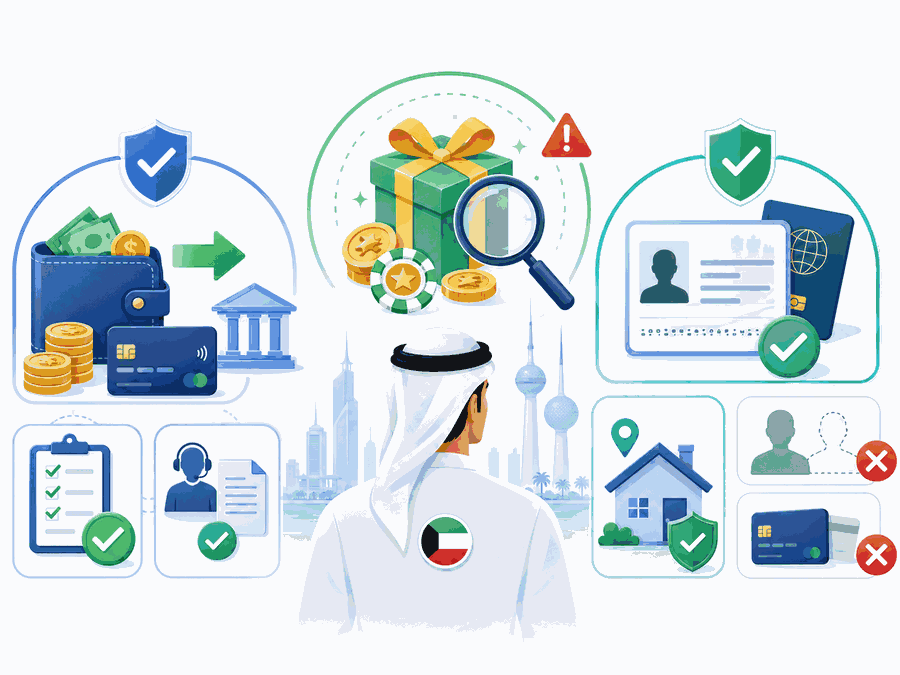
Some players may think that Sports Betting Regulation in the Middle East is only a government issue, but it affects very practical details in the player experience.
Balance and Withdrawal Protection
When a market is regulated, the regulatory authority can impose clear rules on operators. This does not mean guaranteed profit, but it means the player is not left alone if they face a problem with withdrawals, accounts, or terms.
- No withdrawal delays without a clear reason.
- Clear bonus terms before depositing.
- Prevention of arbitrary account closures.
- A formal complaint mechanism.
- Requiring the site to protect player data.
In the absence of local regulation, Kuwaiti players often rely on the offshore site’s terms. If a problem occurs with withdrawals, verification, or account closure, there is no specialized Kuwaiti authority to refer to. For this reason, Sports Betting Regulation in the Middle East matters because it determines who protects the player when a dispute happens.
Clear Bonus Terms
Many players are attracted to bonuses such as a 100% bonus, a free bet, or loss cashback. However, the problem appears in the terms: high wagering, a maximum withdrawal limit, a maximum bet limit, or markets that do not contribute to wagering.
In a regulated market, sites can be forced to display terms clearly. Therefore, Sports Betting Regulation in the Middle East may reduce misleading advertising and make offers more transparent.
Identity Verification
Identity verification may seem annoying, but it is a basic element in any regulated market. In the future, if Sports Betting Regulation in the Middle East expands, it is normal for KYC procedures to become stronger.
What the Site May Request
- ID card or passport.
- Proof of address.
- Proof of ownership of the payment method.
When Does the Problem Appear?
- Using another person’s card.
- Opening an account under a different name.
- Having more than one account for the same player.
For Kuwaiti players, this means that using another person’s card or opening an account under a different name may lead to frozen withdrawals, even on major sites.
The Difference Between Offshore Licensing and Local Licensing
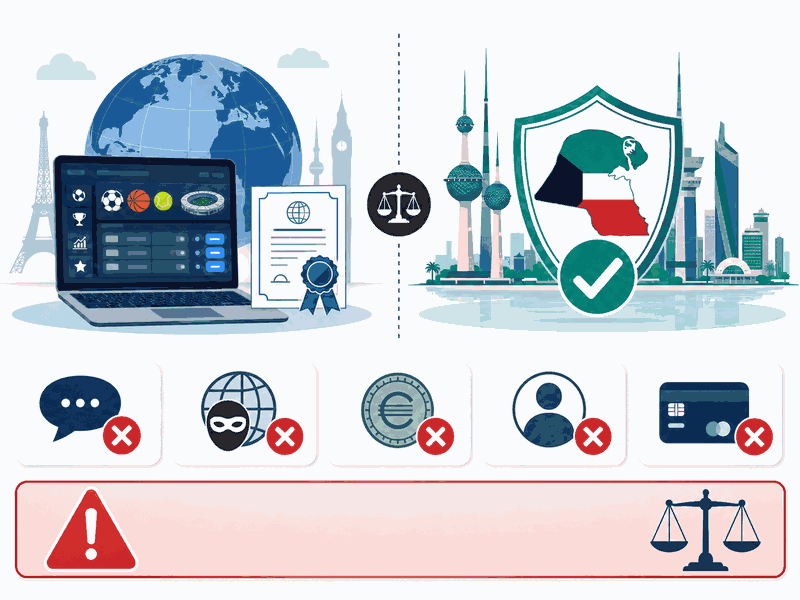
One of the biggest mistakes when discussing Sports Betting Regulation in the Middle East is confusing offshore licensing with local licensing. A site may state that it is licensed by Curaçao, Malta, Gibraltar, or another international authority. This may indicate some form of regulation or supervision in another country, but it never means that the site is licensed inside Kuwait. Local licensing means that the competent authority inside Kuwait itself has allowed the operator to work according to local laws and controls, and this does not currently exist in the field of sports betting.
To understand the difference more simply, players must distinguish between a license that allows a site to operate under the laws of a foreign country and a license that makes it authorized inside their own country. Therefore, accepting players from Kuwait does not mean there is a Kuwaiti license, and having Arabic language on the site does not mean there is local legal protection. Using a VPN also does not make the activity legal, and displaying the Kuwaiti dinar, the US dollar, or any other currency does not change the legal status. In short, an offshore license may show that the site operates under a legal framework elsewhere, but it does not automatically give it any legal status inside Kuwait.
This point makes Sports Betting Regulation in the Middle East more complicated for Kuwaiti players, because some countries may start regulation while others remain under prohibition or non-permission, and this comes down to several factors.
Factors That Will Shape the Future of Sports Betting Regulation in the Middle East
The future of Sports Betting Regulation in the Middle East will not be determined by players’ interest alone. Larger factors control the direction of this sector, such as local laws, the religious and social position, economic interests, tourism, and protecting players from risks.
The Religious and Social Factor

In Kuwait and many Gulf countries, betting is linked to clear religious and social sensitivity. Therefore, any change in Sports Betting Regulation in the Middle East requires broad discussion, not just a commercial decision.
The Economic Factor

Some countries may consider regulation because of tourism, investment, and taxes. If a state sees that the market already exists online, it may prefer to regulate it instead of leaving it completely to offshore sites.
The Digital Factor

The internet has made prohibition harder than before. Players can access offshore sites, and sites can target multiple markets. For this reason, some governments may have to consider middle-ground solutions, such as blocking, payment monitoring, awareness campaigns, or limited licensing.
Protecting Sports from Manipulation

Betting does not affect the player only; it may also affect the integrity of sport itself. When markets exist on small tournaments or lesser-known players, the risks of manipulation increase.
Here, the role of Sports Betting Regulation in the Middle East appears as a way to manage the digital reality, reduce risks, and monitor markets that may affect the integrity of sport.
What Could Future Regulation Look Like?
If Sports Betting Regulation in the Middle East expands in some countries, it is not expected to be open to everyone. It will most likely be gradual, strict, and limited.
- Licenses for a limited number of operators.
- Requiring companies to have strong capital.
- Auditing payment and withdrawal systems.
- Full identity verification for every player.
- Responsible gambling tools.
- Limits on sports advertising.
- Preventing the targeting of minors.
- Monitoring betting markets.
- Cooperation with sports federations.
- An official complaint system.
This means that Sports Betting Regulation in the Middle East is not just about allowing players to bet. It is a complete system that monitors the company, protects the player, and follows market movement.
What Does Regulation Mean for Football Markets?
Kuwaiti players are often more interested in football betting than any other sport. Therefore, the future of Sports Betting Regulation in the Middle East will be strongly connected to football markets.
Popular Markets
- Match result.
- Number of goals.
- Both teams to score.
- Goalscorers.
- Cards and corners.
Markets That Need Higher Oversight
- Live betting.
- Accumulator bets.
- Local league markets.
- Less-covered matches.
- Cards and penalty markets.
In a regulated market, bets on the English Premier League or the Champions League may be easier to monitor because they are global competitions with wide coverage. Bets on smaller local competitions, however, may need stronger oversight, because any unusual betting movement could be a sign of a problem.
Here, the value of Sports Betting Regulation in the Middle East appears from the angle of sports integrity, not only from the angle of player protection.
Comparison Between Prohibition and Regulation
| Element | Complete Prohibition | Licensed Regulation |
| Player protection | Weak if offshore sites are used | Stronger with a regulatory authority |
| Withdrawals | Depends on the site’s policy | Subject to clearer rules |
| Advertising | May come from abroad without enough oversight | Subject to legal conditions |
| Bonuses | May be misleading | Clearer terms and greater disclosure |
| Identity verification | Differs from one site to another | Mandatory and regulated |
| Responsible gambling | Often optional | Often mandatory tools |
This comparison does not mean that regulation will happen in Kuwait soon. However, it explains why Sports Betting Regulation in the Middle East is an important issue when comparing complete prohibition with regulatory licensing.
Tips for Kuwaiti Players Before Using Any Offshore Site
Until the direction of Sports Betting Regulation in the Middle East becomes clearer, Kuwaiti players should be very careful when dealing with any offshore site.
Check the Site Before Registering

- Is the license clearly mentioned?
- Is the name of the owning company visible?
- Are the withdrawal terms understandable?
- Does it accept Kuwaiti documents?
- Are there daily or monthly withdrawal limits?
- Are the bonus terms reasonable?
- Does support answer clearly?
- Are there responsible gambling tools?
Avoid These Mistakes
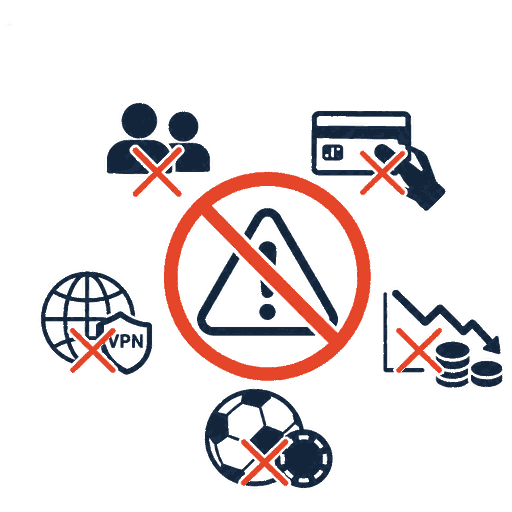
- Do not use a card under another person’s name.
- Do not open more than one account.
- Do not rely on a VPN as a legal solution.
- Do not bet money you need for living expenses.
- Do not chase losses after one match.
- Do not accept a bonus before reading its terms.
- Do not bet on a market you do not understand.
These tips matter because Sports Betting Regulation in the Middle East is still not unified, and Kuwaiti players may not receive local protection if a problem happens with an offshore site.
Could Kuwait Change in the Future?
It is not possible to say for certain, but at the moment there are no strong signs of a licensed sports betting market inside Kuwait. Therefore, it would be inaccurate to say that Kuwait will legalize betting soon. The more accurate view is that Sports Betting Regulation in the Middle East may change in some countries, while Kuwait remains more conservative.
If any development happens in Kuwait, it may start from indirect points such as:
- Clarifying the position on offshore sites.
- Tightening oversight on advertising.
- Monitoring payment methods.
- Awareness campaigns about betting risks.
- Blocking unlicensed sites.
- Official warnings for players.
As for opening a licensed betting market inside Kuwait, this would require a major legal and social change. Therefore, Kuwaiti players should follow news about Sports Betting Regulation in the Middle East carefully, not with exaggerated expectations.
Conclusion on Sports Betting Regulation in the Middle East
The future of Sports Betting Regulation in the Middle East will differ from one country to another. Some countries may move toward regulation because of tourism, investment, and digital oversight, while others will remain under prohibition for legal, religious, and social reasons. Kuwait, at the moment, is not a licensed sports betting market, and there should be no confusion between an offshore site that accepts Kuwaiti players and local licensing inside Kuwait.
For Kuwaiti players, understanding Sports Betting Regulation in the Middle East helps them read the landscape intelligently. Regulation does not only mean allowing betting; it also means player protection, withdrawal monitoring, clear terms, identity verification, prevention of misleading advertising, and monitoring sports manipulation.
Until clearer rules appear, any offshore betting site should be treated with caution. Read the license, understand the withdrawal terms, do not use incorrect details, and do not treat bonuses as free money. This is the practical way to understand Sports Betting Regulation in the Middle East from the perspective of Kuwaiti players.
FAQs About Sports Betting Regulation in the Middle East
What Does Sports Betting Regulation in the Middle East Mean?
Sports Betting Regulation in the Middle East means the laws, authorities, and rules that define how sports betting sites operate in the countries of the region. This includes licensing, player protection, identity verification, advertising oversight, withdrawal terms, and combating sports manipulation.
Does Sports Betting Regulation in the Middle East Mean Betting Is Legal in Kuwait?
No. Sports Betting Regulation in the Middle East does not mean that betting is legal in Kuwait. Kuwait currently does not have a locally licensed sports betting market, and the presence of offshore sites that accept players from Kuwait does not mean they are licensed inside Kuwait.
Does Offshore Licensing Protect Kuwaiti Players?
Offshore licensing may be better than an unknown site, but it is not the same as a Kuwaiti license. When discussing Sports Betting Regulation in the Middle East, players must distinguish between a site licensed abroad and a site licensed locally. Kuwaiti players do not necessarily receive local protection when using an offshore platform.
Will the UAE Change the Future of Sports Betting Regulation in the Middle East?
The UAE may influence the regional discussion because it has started building a regulatory framework for commercial gaming. However, Sports Betting Regulation in the Middle East will not change all at once in every country. Kuwait may remain more conservative, and any UAE development should not be treated as a general Gulf-wide decision.
What Is the Most Important Advice for Kuwaiti Players Now?
The most important advice is not to confuse a site accepting Kuwaiti players with having a local license. Until Sports Betting Regulation in the Middle East becomes clearer in Kuwait, players should read the terms, check the license, avoid duplicate accounts, avoid using another person’s card, and only play with a budget they can afford to lose.